How Long Do Dental Implants Last With Proper Care?
With proper care, your dental implants can last 20–30 years or even a lifetime, with clinical studies documenting survival rates exceeding 90–95% over two decades. The titanium or zirconia post integrates permanently with your jawbone through osseointegration, while the crown typically requires replacement every 10–15 years due to normal wear. Your implant’s longevity depends on meticulous oral hygiene, professional maintenance every 3–6 months, and managing systemic factors like diabetes or smoking that compromise osseointegration. Understanding the key factors affecting durability will help you maximize your investment.
Key Takeaways
- Dental implants can last 20–30 years or a lifetime with proper maintenance, achieving 90–95% success rates over 10–20 years.
- The titanium post integrates permanently with jawbone and rarely needs replacement, while crowns require replacement every 10–15 years.
- Daily brushing, interdental cleaning, and professional cleanings every 3–6 months prevent peri-implant diseases and ensure longevity.
- Smoking, diabetes, and poor oral hygiene significantly reduce implant lifespan by compromising osseointegration and increasing infection risk.
- Implants outlast bridges and dentures by decades, preserving bone structure and reducing the need for repeated replacements.
Expected Lifespan of Dental Implants and Long-Term Success Rates

When properly maintained, dental implants demonstrate exceptional longevity, with clinical evidence showing they’ll last 20–30 years or even a lifetime.
Success rates consistently exceed 90–95% over 10–20 years, with some 30-year studies reporting 100% survival in specific patient populations.
The titanium or zirconia post integrates permanently with your jawbone through osseointegration, while the crown typically requires replacement every 10–15 years due to normal wear.
While the implant post fuses permanently with your jawbone, the visible crown typically needs replacement every 10–15 years.
Early failures occur primarily within the first year at rates of 2–3%, making initial healing critical.
Your implant’s longevity depends greatly on adequate oral hygiene, regular professional maintenance, and avoiding risk factors like smoking or uncontrolled diabetes.
Proper surgical technique and implant design further enhance durability, with minimal bone loss—less than 0.5mm annually—after the first year.
The implant consists of three essential components: the titanium implant post, abutment, and visible restoration creation, each working together to provide stability and function.
Understanding the Difference Between Implant Posts and Crowns
Dental implants consist of two distinct components with markedly different longevity profiles and replacement timelines. The titanium or zirconia post integrates with your jawbone through osseointegration and can function for a lifetime when properly maintained. This surgically-placed foundation typically doesn’t require replacement.
Conversely, the implant crown—the visible prosthetic tooth—experiences wear from chewing forces and material degradation, necessitating replacement every 10–15 years. Posterior crowns endure higher occlusal loads and may require earlier intervention.
Clinical data shows crown survival rates of 50–80% over 15–20 years. You’ll need crown replacement without disturbing the underlying post, preserving your bone integration.
Understanding this distinction helps you anticipate maintenance costs and set realistic expectations for component-specific longevity throughout your implant’s functional lifespan.
Key Factors That Determine How Long Your Implant Will Last

Your implant’s longevity depends primarily on rigorous oral hygiene practices and consistent professional maintenance to prevent peri-implant diseases.
Systemic health conditions like diabetes and lifestyle factors such as smoking greatly compromise osseointegration and increase failure rates.
Clinical evidence shows that patients who maintain ideal oral hygiene and manage underlying health conditions achieve survival rates exceeding 90% over 20 years.
Oral Hygiene and Maintenance
Although dental implants demonstrate exceptional survival rates exceeding 90% over decades, their longevity depends primarily on rigorous oral hygiene protocols and professional maintenance intervals.
You’ll need to implement daily brushing with soft-bristled brushes, interdental cleaning around abutments, and antimicrobial rinses to prevent peri-implant mucositis (12.1% incidence) and peri-implantitis (7.1% incidence). These inflammatory conditions cause progressive bone loss if left untreated.
You should schedule professional cleanings every 3–6 months for plaque removal and early detection of complications. Your clinician will monitor bone levels, as loss typically remains below 0.5mm annually after the first year with adequate maintenance.
Poor hygiene greatly increases failure risk, particularly when combined with smoking or systemic conditions like diabetes.
Early intervention prevents most complications, ensuring your implant functions effectively for 20–30 years or longer.
Health Conditions and Lifestyle
While oral hygiene forms the foundation of implant maintenance, systemic health conditions and lifestyle behaviors exert equally powerful influence on long-term survival outcomes.
Smoking greatly increases failure risk by impairing osseointegration and promoting peri-implantitis. You’ll face compromised healing and elevated complication rates if you’re a tobacco user.
Diabetes, particularly when poorly controlled, similarly threatens implant stability through impaired wound healing and increased infection susceptibility. Your success rates improve remarkably with ideal glycemic management.
Bruxism subjects implants to excessive forces, potentially causing mechanical complications or crown fracture. You should consider a night guard if you grind your teeth.
Other systemic conditions—including osteoporosis, autoimmune disorders, and immunosuppressive medications—may compromise bone density and healing capacity, necessitating careful risk assessment and preventive strategies before implant placement.
How Dental Implants Compare to Bridges and Dentures Over Time
When evaluating tooth replacement options, dental implants demonstrate markedly superior longevity compared to traditional bridges and dentures.
While bridges and dentures typically require replacement every 5–10 years due to material degradation and structural failure, implants maintain functionality for 20–30 years or longer through osseointegration—the biological fusion of titanium with bone tissue.
This fundamental difference in stability greatly impacts long-term outcomes.
Bridges compromise adjacent teeth through preparation and placement stress, while dentures accelerate jawbone resorption without root stimulation.
Implants preserve bone architecture through mechanical loading that mimics natural teeth, reducing the progressive bone loss you’d experience with conventional prosthetics.
Clinical evidence confirms implants function reliably after 20–40 years, far exceeding alternatives.
You’ll avoid repeated replacements, maintain superior chewing efficiency, and prevent the cascading structural changes associated with removable or bridge-supported restorations.
Common Issues That Can Affect Implant Longevity
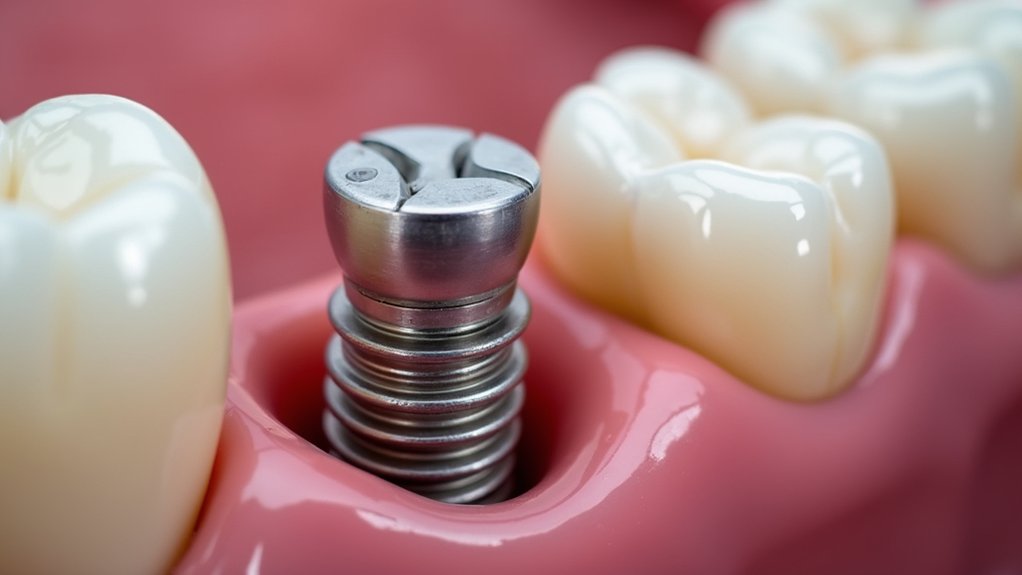
Despite impressive survival rates exceeding 90% over decades, dental implants remain vulnerable to specific complications that you must actively prevent through proper care and risk management.
| Complication | Incidence Rate | Primary Risk Factors |
|---|---|---|
| Peri-implant mucositis | Up to 12.1% | Poor oral hygiene, plaque accumulation |
| Peri-implantitis | Up to 7.1% | Smoking, diabetes, inadequate maintenance |
| Early implant failure | 2–3% | Infection, poor osseointegration, surgical technique |
| Crown wear/fracture | Variable | Bruxism, excessive occlusal forces |
| Progressive bone loss | Minimal after year one | Systemic disease, biomechanical overload |
Infection represents the most preventable threat to implant longevity. Smoking increases failure risk substantially through impaired healing and compromised immune response. You’ll minimize complications through meticulous daily hygiene, professional cleanings every 3–6 months, and managing conditions like diabetes or bruxism. Early intervention proves critical when inflammation appears.
Best Practices for Maintaining Your Dental Implants
Understanding these complications empowers you to implement targeted maintenance protocols that directly address each risk factor.
Your daily oral hygiene regimen must include gentle brushing twice daily with a soft-bristled brush and interdental cleaning using floss or specialized implant brushes to prevent peri-implant mucositis.
Brush twice daily with soft bristles and clean between implants using floss or specialized brushes to prevent infection.
Schedule professional cleanings every 3–6 months to monitor bone levels and detect early signs of peri-implantitis.
If you smoke, cessation is critical—smoking greatly increases failure rates and complications.
Manage systemic conditions like diabetes through medical supervision, as uncontrolled disease compromises osseointegration.
Address bruxism with a nightguard to prevent excessive forces on implant crowns.
Maintain adequate calcium and vitamin D intake to support bone density.
These evidence-based practices minimize bone loss below 0.5mm annually and maintain the 90–95% success rates documented in long-term studies.
Frequently Asked Questions
Can Dental Implants Be Placed Immediately After Tooth Extraction?
Yes, you can receive immediate implant placement after extraction if you’ve got adequate bone density and no infection. However, this approach carries elevated complication risks compared to delayed placement, so careful case selection and proper technique are essential.
Are Dental Implants Covered by Insurance Plans?
Insurance coverage for dental implants varies considerably by plan. Most traditional policies classify implants as cosmetic, limiting coverage. However, you’ll find some plans cover portions—particularly medical policies when implants address trauma, disease, or functional impairment requiring restoration.
How Much Do Dental Implants Typically Cost?
Dental implant costs typically range from $3,000–$6,000 per tooth, though you’ll find significant variation based on your location, case complexity, and whether you need additional procedures like bone grafting or sinus lifts.
Is the Dental Implant Procedure Painful?
You’ll experience minimal discomfort during the procedure due to local anesthesia. Post-operative pain is typically mild to moderate, manageable with prescribed medications, and subsides within a few days as healing progresses with proper care.
What Age Is Too Old for Dental Implants?
There’s no absolute age limit—you’re eligible if you’ve got adequate bone density and good overall health. Your systemic conditions, healing capacity, and oral hygiene matter more than chronological age for successful implant osseointegration and long-term survival.
Conclusion
Your dental implants function like engineered titanium roots that osseointegrate with your jawbone—a biological process taking 3-6 months. With proper maintenance protocols, they’ll achieve a 95% success rate at 10 years and potentially last your lifetime. However, you’re not guaranteed longevity without commitment. You’ll need biannual professional cleanings, daily biofilm removal with non-abrasive techniques, and immediate intervention for peri-implantitis symptoms. Consider this: natural teeth last decades with care, yet fail without it—your implants demand identical diligence for ideal long-term prognosis.
References
- https://www.loudfamilydentistry.com/blog/dental-implants-related-statistics-on-longevity-and-functionality
- https://blyssdental.com/how-long-do-dental-implants-last-5-lifespan-factors-and-tips/
- https://www.drsilegy.com/how-long-do-dental-implants-last/
- https://www.periodontal.com/how-long-do-dental-implants-last/
- https://pmc.ncbi.nlm.nih.gov/articles/PMC10982840/
- https://www.healthline.com/health/dental-and-oral-health/how-long-do-dental-implants-last
- https://pubmed.ncbi.nlm.nih.gov/18181931/
- https://www.copperminedental.com/what-happens-to-dental-implants-after-20-years/
- https://hssh.health/blog/how-long-do-dental-implants-last/